Design-Forward Strategies To Sell Your Buckhead Home Faster
July 9, 2026
July 9, 2026
If your Buckhead home is competing for attention, great design is not just a nice extra. It can be the difference between getting dismissed online and getting a strong showing calendar. In a market where buyers often compare many homes before they ever step through the door, thoughtful presentation helps your property stand out, support its price, and create momentum from day one. Let’s dive in.
Buckhead is widely known for its polished, luxury-forward identity. Public sources describe Buckhead Village District as an eight-block destination with high-end retail and dining, and that broader sense of quality shapes buyer expectations before they even visit a listing.
That matters because buyers do not evaluate your home in a vacuum. They compare it to the surrounding lifestyle, to nearby listings, and to the overall standard they expect in Buckhead. If your home feels visually dated, cluttered, or underprepared, that gap can show up quickly in both interest and offers.
Recent market data suggests Buckhead remains active, but sellers still need to be strategic. Redfin reported a median sale price of $769,741 over the three months ending May 2026, about 42 days on market, and an average of three offers per home.
Realtor.com’s May 2026 snapshot showed a median sold price of $785,000, 56 median days on market, and a 98% sale-to-list ratio, while classifying Buckhead as a balanced market. The exact numbers differ by source, but the takeaway is consistent: this is not the kind of market where presentation can be ignored.
One of the biggest mistakes sellers make is treating Buckhead like a single price point. It is not. Realtor.com data shows meaningful variation across the area, with Tuxedo Park around a $1.745 million median listing price, Brandon around $2.059 million, and Buckhead Village around $325,000.
That means your strategy should match your immediate competition, not just the Buckhead label. A design plan that works for one part of Buckhead may miss the mark in another, especially when buyer expectations, finish levels, and pace differ from one pocket to the next.
Staging is often treated like decor, but the better way to see it is as market positioning. According to the National Association of Realtors 2025 Profile of Home Staging, 29% of agents saw staging increase the dollar value offered by 1% to 10%, and 49% of sellers’ agents said staging reduced time on market.
Just as important, 83% of buyers’ agents said staging made it easier for buyers to picture a property as a future home. That shift in perception matters because buyers often make fast emotional judgments, especially online.
If you are deciding where to focus your time and budget, the data offers a clear starting point. NAR found that the most important rooms to stage were:
These are the spaces where buyers tend to form their strongest impressions. In Buckhead, where many buyers expect a polished, elevated look, these rooms should feel clean, current, and easy to understand at a glance.
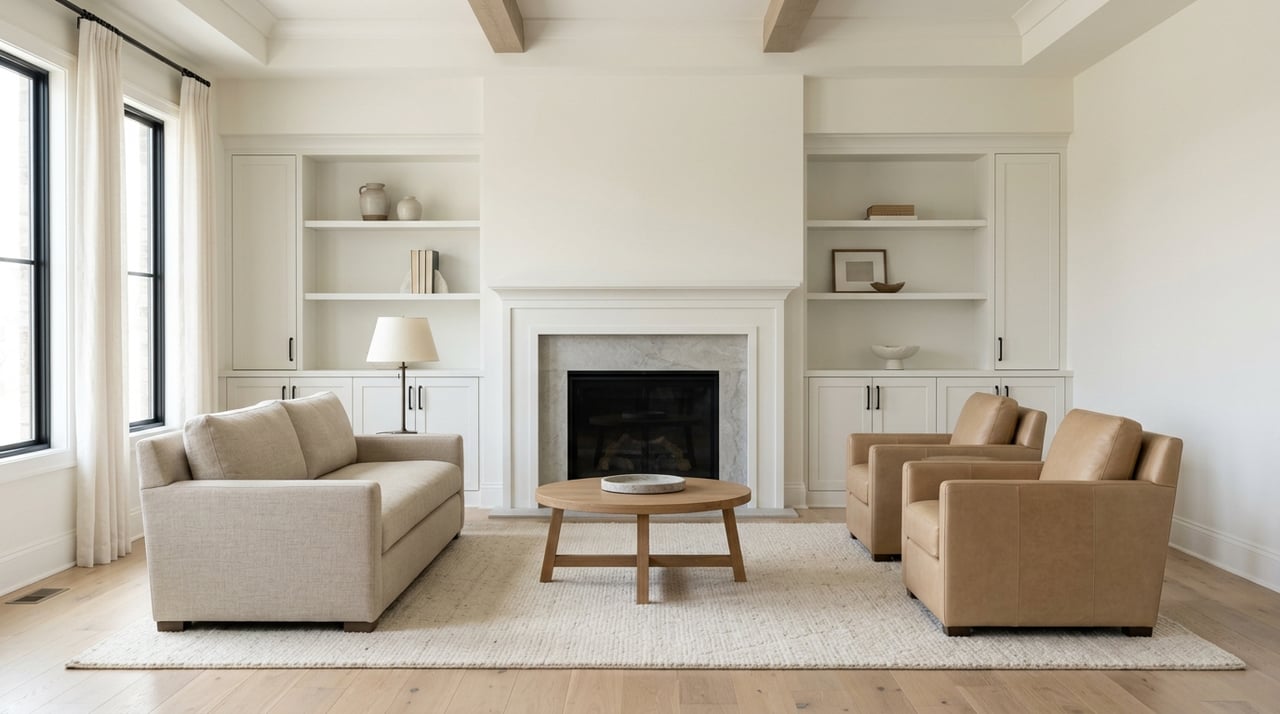
The living room often sets the tone for the entire showing. It should feel open, balanced, and useful, with furniture scaled to the room and enough negative space to let architectural details stand out.
If the room is overcrowded or overly personal, buyers may focus on what feels off instead of what makes the home special. A quieter visual approach usually helps the space read larger, brighter, and more expensive.
The primary bedroom should feel restful and intentional. Crisp bedding, simplified surfaces, and a furniture layout that supports flow can make the room feel more inviting without adding clutter.
In many homes, this space is also where buyers start judging whether the home feels truly move-in ready. A polished primary suite helps support that impression.
The kitchen is one of the easiest places for visual noise to hurt buyer perception. Too many items on counters, mismatched finishes, or weak lighting can make even a good kitchen feel busy.
A cleaner, lighter presentation helps buyers focus on the features that matter most, such as workspace, storage, seating, and overall condition. In listing photos, this room needs to look crisp and highly functional.
Before any styling details come into play, the most recommended pre-listing improvements are refreshingly simple. NAR found that agents most often advised sellers to focus on:
These steps work because they remove distractions. Buyers can focus more easily on layout, natural light, finishes, and potential when they are not processing extra visual noise.
Decluttering is not about stripping a home of personality. It is about editing the space so buyers can read each room quickly and clearly.
That may mean removing excess furniture, clearing countertops, simplifying shelves, and storing items that interrupt flow. The goal is to make the home feel larger, calmer, and easier to imagine as their own.
A clean home signals care. It also helps every finish photograph better, from floors and tile to windows and countertops.
In a design-forward sale, cleanliness is part of the visual strategy. Dust, smudges, and buildup can undercut even the best staging plan.
Buyers begin judging your home before they walk inside. Fresh landscaping, tidy entries, clean walkways, and a well-maintained exterior create a stronger first impression and support the value story from the start.
This is especially important in Buckhead, where exterior presentation often plays a major role in how a listing is perceived. A polished entry can make the home feel more complete before the showing even begins.
For premium listings, strong visuals are not optional. NAR reported that buyers’ agents rated photos, traditional physical staging, videos, and virtual tours as much more important or more important to clients.
Sellers’ agents also ranked photos, videos, and physical staging as highly important listing assets. That means your launch should not rely on a few quick photos and a rushed go-live date.
Many buyers narrow their list online first. NAR found that among respondents whose buyers had expectations, the median buyer expected to see 20 homes virtually and eight homes in person before buying.
That tells you something important: your home has to win digitally before it gets the chance to win in person. If the listing photos feel dark, empty, inconsistent, or unfinished, buyers may move on before booking a showing.
A strong launch works best when staging, photography, video, and marketing materials are ready before the home hits the market. That creates a more cohesive first impression and helps capture interest early.
Realtor.com also advises sellers to wait until the home is in good shape before listing, including fixing defects and improving appearance with updates like repainting and landscaping. In other words, speed to market matters less than being fully prepared when you do launch.
Not every Buckhead home needs a major overhaul before listing. In many cases, the most effective improvements are cosmetic and strategic.
Depending on the home, that may include repainting, light landscaping, updated styling, refined furniture placement, or a more intentional lighting plan. The goal is not to redesign the home for your taste. It is to present it in a way that supports buyer confidence and market value.
Realtor.com’s 2026 analysis identified April 12 through 18 as the best time to sell nationally based on historical patterns, including slightly higher prices, more views, less competition, and faster sales. But local conditions still matter, and timing alone will not make up for weak presentation.
If your home is not ready, waiting can be the smarter move. A polished, well-timed launch usually gives you a better chance of attracting serious buyers than listing early with unfinished details.
If you want to sell your Buckhead home faster, focus on a plan that blends design, prep, and execution. Start with the rooms that shape buyer perception most, improve the basics, and make sure your visual marketing is complete before launch.
In a balanced or somewhat competitive market, thoughtful presentation can help your home stand apart without leaning on aggressive pricing alone. That is where a design-first strategy becomes practical, not just pretty.
If you are preparing to sell in Buckhead and want a polished, project-managed approach, Heather Cummings can help you position your home with smart design, strong visuals, and a launch plan built for your specific market.

REALTOR®
Blending her knowledge of architecture and design with the soft skills she perfected in sales and customer service, Heather has established herself as an elite agent, specifically as an expert Atlanta Real Estate Agent, with a gift for concierge-style service and a heart for working with people navigating transitions and milestones. Her specialized services include luxury home marketing and assisting buyers who are moving to the Atlanta area from another country.
Search homes for sale, browse things to do, and discover neighborhood demographics in Atlanta's best neighborhoods.
Stay up to date on the latest real estate trends.


Your Guide to Buying a Brookhaven Home That Adapts as Your Family Grows.
What Today's Chamblee Homebuyers Want From a Home's Interior Design.

Reading a Chamblee Floor Plan Like a Designer Before You Make an Offer.


A Family's Guide to Buying a Home Near the Mercedes-Benz Atlanta Campus.

Using My Designer's Eye to Spot the Potential in a Dated Buckhead Home.

A Buying Guide for Dual-Income Families in Atlanta.
From conducting thorough consults to project-managing upgrades to personally staging homes and catering the marketing to the style of the house, Heather’s clients are treated to a guided, cared-for process in which they are a relationship, not a sale.